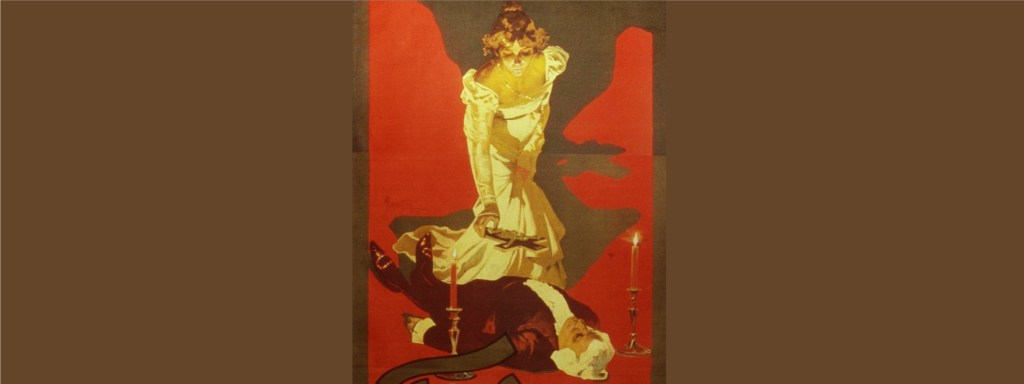
Image credit: https://en.wikipedia.org/wiki/Tosca#/media/File:Tosca_(1899).jpg
ROLES
Floria Tosca, a celebrated diva – soprano
Martino Cavaradossi, a waiter – tenor
A seamstress – consumptive
A patron sitting in Row D, Seat 16 – mezzo-consumptive
An orchestra
A tubaist
A maestro
A flock of sheep
The last sheep – contralto
A shepherd boy – alto
A former chief of police – baritone
Various voices from off-stage above
THE THIRD ACT
The Courtyard of the Angel, Castel Sant’Angelo, Rome
(It is still night. A clear sky glitters with stars, yet little by little the stars disappear as the grey, uncertain light of the hour before dawn replaces the darkness. Church bells toll for matins.
Martino Cavaradossi, a tall, dark-haired, handsome man, enters stage right through the courtyard entrance and rushes over to Raffaello’s statue of Michael the Archangel that stands centre stage. He leans against the statue base as he catches his breath. Recovered, he paces back and forth between the statue and the doors of the Chapel of Leo X at the edge of stage left.
Martino wears a waiter’s apron, a pen behind his right ear and a look of eager anticipation on his face. He stops often, and with his hands placed upon his chest, he looks longingly and lovingly up towards the parapet guarding the terrace of Castel Sant’Angelo several stories above.
A thin, pale yet beautiful seamstress enters stage right and shuffles towards the statue. She wears a shawl over her head and clutches it with tiny, frozen hands. She stops and removes a needle and thread from her pocket and attempts to thread the needle with shaking hands, but she fails as she is overcome with a bout of intense shivering, followed by a hacking cough that causes her to double over. Once finished, she stands taller, hawks and spits.
Martino waves to get her attention. Succeeding, he places his index finger to his lips and points her towards the chapel doors. She acknowledges his request with a louder and longer coughing fit. He rushes forward and offers her a handkerchief. She coughs and coughs and reddens the handkerchief. He places his arm around her stooped shoulders and ushers her towards the chapel. Still she coughs and coughs, followed by another hawk and spit. An anxious look fills Martino’s face as she smacks her lips. He removes a medicine bottle and a spoon from beneath his apron. She coughs. He pours a spoonful of medicine. She coughs and coughs. He administers it to her. She swallows and is silent. Martino sighs in relief, only for the woman’s coughing fit to return, louder and longer and more violent. With a panicked glance towards the parapet above, Martino offers the woman the bottle. She accepts, nods her thanks, raises the bottle in toast and drains it in three gulps. She goes to cough but collapses at Martino’s feet. He picks her up, throws her over his shoulder and carries her to the chapel and through its open doors.
Martino returns onstage, brushing his hands together to signify a job well done. A stifled cough comes from the stalls. Martino pauses, cocks an ear and listens. A prolonged bout of coughing follows. Martino steps to the edge of the apron and glowers at the offender: a patron sitting in Row D, Seat 16. The coughing ceases. Martino turns towards the statue, but a loud sneeze from the patron sitting in Row D, Seat 16, echoes about the opera house. Martino whips around to the audience, places his hands upon his hips and glowers long and hard. A prolonged, uncomfortable silence ensues until Martino, following a finger point and head shake at the patron sitting in Row D, Seat 16, returns to centre stage.
Church bells continue tolling for matins.
Martino resumes pacing between the statue base and the chapel doors. Again he stops often and places his hands upon his chest and looks longingly and lovingly towards the parapet above. He holds up his thumb as a sighting tool and measures the distance between the courtyard and the parapet. As he counts with his fingers, the sound of many shuffling feet comes from the stage right wing. Martino looks up, and his eyes widen and whiten as an orchestra wanders onstage. The musicians are dressed in either elegant black gowns or smart black tuxedos, and all tune their instruments. Waving his arms, Martino rushes towards the musicians and tries to hush them. All ignore him and continue to meander across the stage whilst releasing a cacophony of chaotic noise. Martino drops to his knees and clasps his hands and begs the musicians to desist and turn and exit stage right. All ignore him and continue to meander and release their cacophony of chaotic noise. Martino pulls a leather pouch from beneath his apron and attempts to hand gold coins to the musicians. Still they ignore him. Still they meander. Still they release their cacophony of chaotic noise. Martino moves to the front of the group and raises his hands. He conducts an andante tempo. The orchestra responds with a jaunty tune and step. Martino increases the tempo to allegro. The musicians fall into formation and parade forward. Martino’s arms flail in a frenzy as he increases the tempo to prestissimo. The musicians break into a run and disappear in single file into the chapel.
Standing beside the chapel door, Martino arms collapse to his sides and his shoulders slump in exhaustion. He wipes his brow with his apron, straightens and turns, only to gasp. Stage right, a tubby tubaist remains, plodding forward in larghissimo whilst releasing periodic honks of his tuba. Martino pulls his hair, gnashes his teeth and rents his apron. He rushes across the stage, grasps the tuba’s bell and attempts to drag the instrument and its owner towards the chapel. Unperturbed, the tubaist continues to plod forward and honk. Martino walks up behind the tubaist and attempts to push him towards the chapel, first with hands, then with shoulder and finally with his back. Still the tubaist plods forward whilst honking. Martino walks around and stands beside the tubaist. He raises his head towards the parapet, places his hands behind his back, feigns a pouty whistle and extends a long leg out in front of the insouciant tubaist. The tubaist plods forward, trips on Martino’s extended leg, stumbles forward and releases a honk of distress as he lands with a thud. Martino grabs the tubaist by the shoe and drags him and tuba towards the chapel. The tubaist blasts rapid honks of protest. Arriving at the chapel entrance, Martino drags the tubaist inside, then reappears in a rush and attempts to slam the chapel doors closed, only for them to jam against a reappearing tuba, which releases a sombre double whole note. Martino raises his leg and delivers a resounding kick that results in the tuba disappearing and the chapel doors slamming shut with a boom. Martino uses his back to brace himself against the door. He raises his head and hands towards the heavens as if imploring the opera gods for a moment or two of golden silence.
Church bells continue tolling for matins.
Martino returns to centre stage. Again he places his hands upon his chest and looks longingly and lovingly towards the parapet above. He removes an anemometer from beneath his apron and raises it above his head and measures the speed and direction of the breeze sweeping the courtyard.
A distant squeak comes from the stage right wing. Martino pauses, cocks his ear towards the right of the stage and listens in stillness. After a lengthy silence, he shakes his head and resumes his wind measurement.
A prolonged squeaking comes from the stage right wing. Martino turns and his eyes widen and whiten as the sound grows louder and nearer. A wheeled walking frame appears stage right, followed by a frail old man, a maestro, shuffling forward. He is stooped, with a mop of grey, wiry hair, and wears an oversized, ill-fitting tuxedo. A baton rests in the breast pocket of his jacket.
Martino rushes across the stage and halts the frail old man. Removing an oil can from beneath his apron, Martino kneels and oils the wheels. Finished, he stands, and with a flourish of his hand, he invites the maestro to proceed towards the chapel.
The maestro takes an unsteady step. The walking frame’s wheels squeak. The maestro takes another unsteady step. Again the walking frame wheels squeak. Martino shakes his head and lifts the old man and places him upon the walking frame’s seat. The old man grasps his baton and strikes Martino on the head repeatedly. Upon each strike, the orchestra booms a single note from within the chapel.
Martino attempts to lift the maestro and walking frame. Three times he tries; three times he fails; three times the orchestra booms. Now puffing, Martino stands the maestro up, places his gnarled hands upon the walking frame handle, raises the old man’s legs by the ankles and wheels him across stage. Arriving at the chapel entrance, he opens the doors, waves a threatening index finger at those within and disappears as he wheels the maestro through the chapel entrance. He returns onstage and closes the chapel doors.
Church bells continue tolling for matins.
Martino returns to centre stage. Again he places his hands upon his chest and looks longingly and lovingly towards the parapet above. He then counts with his fingers but stops and shakes his head. He looks out beyond the apron and raises his index finger as a look of realisation appears on his face. He removes a calculator from beneath his apron.
As he goes to tap the buttons, a sheep’s bleat sounds from the stage right wing. Martino pauses, cocks his ear towards stage right and listens in stillness. After a long silence, he shakes his head and commences tapping buttons on the calculator, only to be interrupted by the loud bleating of a flock of sheep from the stage right wing. He turns and disbelief spreads across his face. A sheep enters stage right, only to freeze with stage fright and release a sizeable pile of droppings. More sheep appear and freeze and release copious more droppings. Martino opens the chapel door. He waves a clenched fist towards the open doorway when a tuba sounds a hopeful honk. Martino walks across the stage until he is amidst the bleating sheep. He ushers them toward the chapel. All but one oblige as they head single-file across stage towards the chapel entrance. Martino pauses and sits on a bench against the wall at the rear of the courtyard between the statue and the chapel, and with his index finger he counts the sheep as they pass him and disappear one by one through the chapel entrance. He yawns and closes his eyes. His head drops and rests on his chest. He sleeps, only to be woken by a loud bleat from the last sheep, who lingers stage right.
Leaping to his feet, Martino rushes across the stage and towards the last sheep. The last sheep bleats and drops droppings. Martino points towards the chapel. The last sheep bleats and drops more droppings. Martino raises a threatening fist. The last sheep bleats and drops even more droppings. Martino plants a well-directed kick upon the last sheep’s rear. Now bleatless and shitless, the last sheep scurries towards stage left. As she reaches the entrance to the chapel, she pauses, turns around and raises a foreleg with an open hoof.)
THE LAST SHEEP (aria)
[IT] Baastardo!
[EN] Baastard!
(With a flourishing turn and a twirl of her fleece, the last sheep disappears through the chapel entrance.
The audience bursts into spontaneous applause, accompanied by whistling, foot-stomping and impassioned shouts of ‘Brava!’. Bouquets rain down upon the stage as the last sheep reappears from stage left, stands upon the apron and gracefully bows before an adoring audience. Holding a bountiful bouquet, she blows kisses to the patrons and taps her chest with her open hoof and nods and mouths her thanks. She turns and applauds the orchestra and maestro within the chapel. Following a final prolonged bow, the last sheep exits stage right.
Meanwhile, Martino stands and waits. Frustration grows on his face as he waits for the applause to cease, waits while stagehands collect dozens of bouquets left upon the stage and waits while a stagehand roams the stage and sweeps sheep droppings into a pan.
At last the stage is Martino’s alone.
Church bells continue tolling for matins.
Martino returns to centre stage and looks towards the parapet above. He places his hands upon his chest and again looks longingly and lovingly upward. He removes the calculator from his pocket, and his fingers vacillate between vigorous taps and head-scratching, only for the ringing of a mobile phone in the audience to interrupt him. Martino storms to the stage’s apron and points at the owner of the offending phone. Row D. Seat 16. Martino raises his head and runs his index finger across his throat. The ringing ceases.
A prolonged and uncomfortable silence ensues as audience and tenor wait. Two security guards arrive and eject the patron in Row D, Seat 16, from the opera house.
Martino turns and shakes his head as he returns to the shadow of the statue. Again he places his hands upon his chest and looks longingly and lovingly upward. He retrieves his calculator and punches out one last calculation. He stands tall and goose-steps ten long strides towards the chapel doors. He stops beneath the second to last crenel to the left of stage. He removes a piece of chalk from beneath his apron, bends and marks out a large ‘X’ upon the stage floor. He stands, and as he admires his handiwork, a shepherd boy enters stage right.
With a beaming smile and wearing his top hat askew, the shepherd boy breaks out into a tap dance. He twirls his crook. He shimmies and glides. He heel-steps and buffalos. He plants his crook and bojangles around it. He stops and raises his arms and throws his head back and opens his mouth to belt out a song, but freezes when he sees Martino glowering at him.
Martino reaches under his apron and whips out a taser gun. He braces himself in the shooting position and aims the gun at the shepherd boy. He fires the taser across the stage.)
A SHEPHERD BOY (aria)
[IT] Ahia!
[EN] Ouch!
(The shepherd boy clutches his chest, teeters forward and lands with a thud, crushing his top hat. His crook clatters to the stage beside him.
Martino rushes across stage, picks up the crook, wraps its hook around the shepherd boy’s neck and drags him across stage to the entrance of the chapel. Martino opens the chapel door and waves a clenched fist towards the open doorway when a tuba sounds a hopeful note. Martino disappears through the chapel entrance whilst dragging the shepherd boy. Martino reappears in a rush and knocks over a plant pot when attempting to slam the chapel door closed, only for the door to jam against the reappearing tuba, which releases a sombre double whole note. With his back against the door and his legs extended and braced, Martino removes his apron and shoves it down the tuba’s bell. As the tuba’s note is stifled, Martino succeeds in slamming the door closed.
Martino reaches down amongst the pot fragments and picks up a key. He inserts the key into the door and locks the chapel. Satisfied the door is secure, he returns to and stands upon the marked ‘X’ with his back to the audience. He removes his order pad from his back pocket and his pen from behind his ear and goes to write. He stops, looks towards the parapet above and sighs. He chews the top of his pen whilst in prolonged, deep thought. Again he goes to write on the order pad, but his hands drop to his sides, and he turns to the front of the stage and gazes out beyond the apron. He moistens his lips with a sweep of his now blue tongue.
The church bells cease tolling for matins, and the orchestra plays the opening strain to “E lucevan le stelle”.)
MARTINO (aria)
[IT] E lucevan le stelle,
[EN] And I wait in dawn’s first light,
[IT] Ed olezzava la terra
[EN] Below the second crenel to the right
[IT] Stridea l’uscio dell’orto
[EN] Heeding the words of my heart’s desire
[IT] E un passo sfiorava la rena.
[EN] ‘Ready yourself at the sound of platoon fire.’
[IT] Entrava ella fragrante,
[EN] I’ve measured wind with anemometer and height with hand,
[IT] Mi cadea fra la braccia.
[EN] And marked with an ‘X’ where I’m to stand.
[IT] O dolci baci, o languide carezze,
[EN] So with open arms and braced feet,
[IT] Mentr’io fremente le belle forme disciogliea dai veli!
[EN] I await my lover’s famous last leap!
[IT] Svanì per sempre il sogno mio d’amore.
[EN] O God, spare my knees and back from harms.
[IT] L’ora è fuggita, e muoio disperato!
[EN] As my dearest falls into my loving arms!
[IT] E muoio disperato!
[EN] O Floria! My love, my life, my fate!
[IT] E non ho amato mai tanto la vita!
[EN] Never has a waiter waited upon matters of such weight!
(Silence fills the courtyard. Martino stands, looks up and waits. After a lengthy period of still silence, he scratches his behind. He removes a fob watch from his front pocket and checks the time. He pockets the watch, extends his left leg and stretches his hamstring. He repeats the stretch on his right leg. He stands, joins his hands and twiddles his thumbs. He folds his arms and strums his fingers. He removes a newspaper from his rear pocket, retrieves the pen from behind his ear and completes that day’s crossword, cryptic crossword and Sudoku. Once finished, he casts the newspaper aside and balances the pen on his nose, leaving a blue dot at the tip of his nose. He removes a glittering silver glove from his pocket, places it on his left hand and faces the chapel doors. He turns his face to the audience, tilts his head down, pouts and moonwalks back to the statue. He stops and performs a double spin, only to freeze facing the audience with his gloved hand raised and his other hand clutching his groin. He pulls a puppet balloon from his pocket and blows and blows and busies himself tying a knot.
A man, a former chief of police, somewhat worse for wear, enters stage right and lumbers forward several steps before stopping and looking up to the parapet above. He has a pale face and a dagger protrudes from his back. He places his skeletal hands upon his blood-soaked shirt and ogles upwards.)
FORMER CHIEF OF POLICE (shouting lustfully)
[IT] Tosca, finalmente mia!
[EN] Tosca, now you are mine at last!
(Between urgent glances at the lustful former chief of police, Martino twists and twists the inflated balloon and produces a dagger. He aims and throws the dagger, which drifts across the stage and strikes the former chief of police full in the breast, ending his shout of lust in a cry of anguish.)
[IT] Buco del culo!
[EN] Accursed one!
[IT] Guai a me! Morire due volte nella stessa notte! Parla di sfortuna! E ad un cameriere!
[EN] Help! I am dying! Help! I die!
(The former chief of police staggers backwards and exits stage right through the courtyard entrance. Only his boots remain visible as he shrieks in a voice nearly stifled with blood.)
MARTINO (shaking a fist towards the boots)
[IT] Questo è il bacio di Martino!
[EN] That is the kiss of Martino!
(Martino sits cross-legged upon the marked ‘X’ and stares out beyond the apron. He waits. He yawns. He waits. His eyelids droop. He waits. His head teeters. He waits. His shoulders slump. He waits. His eyes close as the sky lightens with dawn’s arrival. And he sleeps.
A bell strikes five.
Rifle shots come from the terrace above. Startled, Martino jumps to his feet and staggers about until he finds and stands upon the marked ‘X’.)
MARTINO (recitative)
[IT] Mi sono quasi cagato!
[EN] It is five and the platoon has fired!
(Martino spits on his hands and rubs them together. They blue. He braces his legs, extends his arms and looks up to the crenel above. He cricks his neck and licks his blue lips.
A woman’s voice comes from the terrace above. Martino cocks his left ear upwards, but her entreaties are lost to the wind until, suddenly, a long, harrowing scream is heard.)
A WOMAN’S VOICE (shouting from the terrace)
[IT] Mario! Mario! Morto! Morto!
[EN] Mario! Mario! Dead! Dead!
[IT] O Mario, cosa devo ordinare? Un grande mac? Un quarto di libbra? Un filetto di pesce?
[EN] Oh, Mario, dead? You? Like this? Dead like this?
(Another scream—again loud and harrowed—comes from the terrace above, followed by confused, unintelligible voices.)
A MAN’S VOICE (shouting from the terrace)
[IT] Due polpette di manzo, salsa speciale, lattuga, cipolle, formaggio, sottaceti, su un panino ai semi di sesamo!
[EN] You’ll pay for his life most dearly!
A WOMAN’S VOICE (shouting from the terrace)
[IT] Avrò le patatine fritte con il mio ordine!
[EN] With my own!
MARTINO (recitative)
[IT] È l’ora dei macca!
[EN] At last she is coming!
(A huge, dark-haired woman of many chins and wide girth, Floria Tosca, appears above at the parapet. She wears a stunning scarlet gown half-hidden by an enormous napkin tucked under her last chin. She steps up and, panting, squeezes her body within the confines of the second crenel—to the right of stage! Recovering her breath, she raises an arm and her head to the heavens.)
FLORIA (shouting)
[IT] O Scarpia! E un grande frullato al cioccolato!
[EN] Oh, Scarpia! Before God!
MARTINO (shouting)
[IT] No! Non il pasto in famiglia! No!
[EN] No! Not from there! No!
(She leaps from the parapet. Martino rushes across the stage with his arms outstretched. As Floria falls, Martino trips. He stumbles. He falls. He crashes. He recovers. He crawls. He staggers. He hobbles. He leaps. He dives. Alas, Floria lands with a thud just beyond his blue fingertips.
A distant tuba honks a resounding note of triumph.
Martino crawls over and reddens in the face as he strains to raise a limp Floria in his arms. Half-succeeding, he raises his face to the heavens, and as tears stream down his flushed cheeks, his blue lips quiver.)
MARTINO (aria)
[IT] Floria! Floria! Morta! Morta!
[EN] Floria! Floria! Dead! Dead!
[IT] O Floria, avanto a Dio! Come potevo sapere che intendevi il tuo diritto e non il mio diritto?
[EN] O Floria, before God! How was I to know you meant your right and not my right?
(Martino sobs as the orchestral finale reaches a crescendo, and with a final clash of cymbals, the stage lights snap to darkness.)
Fine dell’opera
(End of the opera)
 martinsmithstories
.jpg)