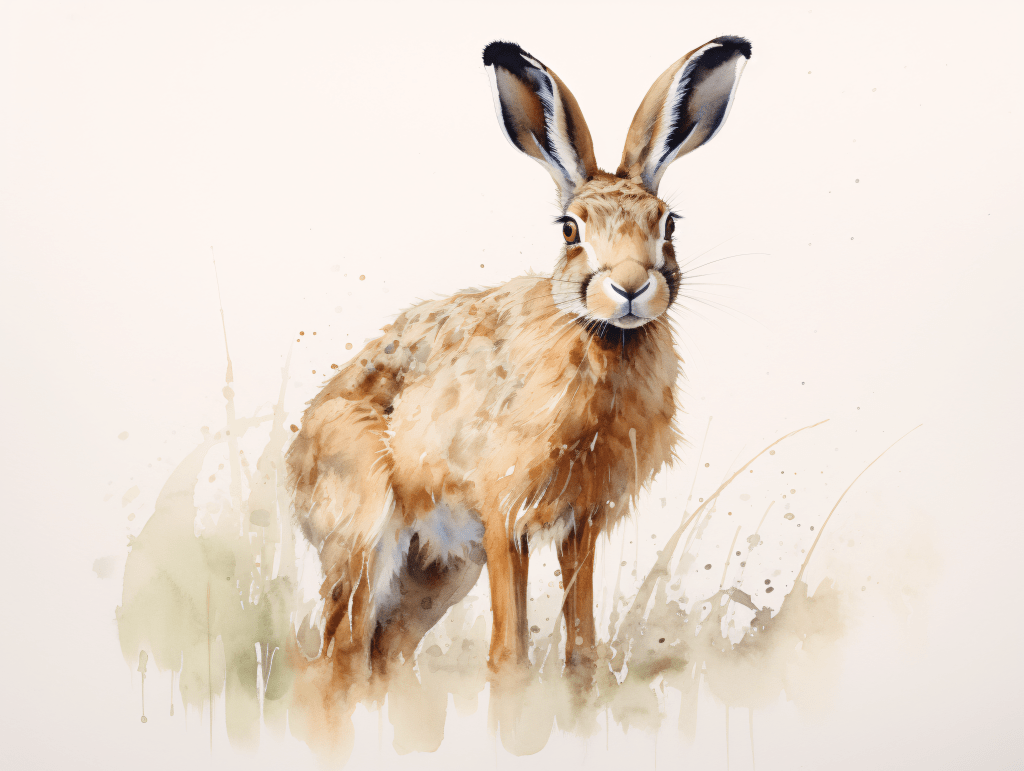
Image by Andreas G from Pixabay
Present Day
Hare and Mrs Hare, both stooped and wielding canes, stood on the footpath across the road from a thatched-roofed cottage with a red door.
‘Off you go,’ Mrs Hare said.
‘Pardon?’ Hare said.
‘Off you go. All you need to do is cross the street, knock on the door and ask him.’
‘I … I … I don’t want to. I can’t.’
He stared forlornly at the familiar cottage. There was absolutely no way he was going back in there, not after two-and-a-half millennia of humiliation, two-and-a-half millennia of anguish and two-and-a-half millennia of all and sundry labelling him the world’s biggest loser. Besides, he wasn’t a leveret anymore. He was on his last legs. What could the wordy bastard who’d got him into all this trouble in the first place do now, after all these centuries?
‘Don’t you “I can’t” me, Hareld Hare,’ Mrs Hare said. ‘I’ve had two-and-a-half thousand years of your whining, your “Oh, poor me, I was robbed” laments, and I’m sick of it. I’ve had it up to my top incisors. You’re ill and need help. You need closure. And the only way you’re going to be at peace with yourself in your latter years is to be a buck for once in your life and cross the street and knock on that door. Now, hop to it!’
Peace? Hare thought. Pff! If only. He remembered the day of the Great Race as if it had been yesterday. Having never been fitter nor healthier nor more confident in all his life, he’d shot out of the blocks and hardly raised a sweat or a puff. Well, not before the Great Nap, that is. If only someone had invented the alarm clock back then, he would not have overslept, and victory and eternal glory—not to mention being seen as the positive role model when the pithy moral was conveyed at the fable’s end—would have and still be his.
But no, he, like some old fart, had plopped his chin on his chest mid-race and counted zeds. What had he been thinking? Then to wake and see Tortoise in the distance under the Finish banner, performing a victory jig amidst congratulatory backslaps. Oh God! Just the memory of it made him want to throw up his breakfast of puréed carrots with such force that his false buck teeth displaced.
Then there was the post-race presentation. He had to pose with his sinewy arm wrapped around Tortoise’s shell and grin a feigned smile as if he was gracious in defeat; meanwhile, inwardly, the anger of a bitter loser raged. The press conference followed, and he lied through gritted buck teeth, espousing such clichés as ‘Not my day’, ‘Beaten by the better athlete’ and ‘Just got to move on with the rest of my life’. When the conference wrapped up, he shook Tortoise’s hand, excused himself, walked back to the changing room, locked the door and spent the next fifteen minutes ransacking the room with seething violence.
And so began the ‘rest of his life’. No fame, no fortune, no gilt-edged portrait hung in the hallowed halls of the Museum of Legendary Sporting Protagonists. Just infamy and poverty and the constant dredging up by academics and feature writers when writing about the greatest losers of all time, and him topping every poll that asked: Who was the greatest choker in the history of world sport? Parents throughout the world read his story bedside at night to sleepy-eyed children, and the little brats, heeding the sage moral of his cautionary fable, mocked his foolishness, his arrogance, his cockiness. Even worse, whenever a child asked their mummy or daddy what a hare was, the parent would plunge the dagger deeper into Hare’s slighted soul by replying, ‘Oh, that’s just a rabbit.’
Had he been Tortoise, he would have retreated inside his shell, away from the prying eyes and analyses of the world’s press and its gullible herd of readers. Instead, he, penniless and homeless, withdrew to the seclusion of his parents’ burrow and wallowed in self-pity. He stopped running, binged on carrots and smoked grass. His belly bulged and his pelt thinned and his mind rotted. ‘Get yourself a therapist,’ his father urged. But all Hare did was lie on the therapist’s couch and talk and talk and resolve nothing. ‘Get yourself a wife,’ his mother urged. And Hare married Harereit, the only doe in the borough who read neither fiction nor the sports section of the newspaper. ‘Get yourself a job,’ Harereit urged. And Hare sighed and rolled over and rolled himself another joint.
For two-and-a-half millennia he’d tried to forget and move on. But all to no avail. He and the world never forgot—him and his infamous loss.
And here he was, back where it had all started and being urged to once again humiliate himself on the slightest chance that another being might right a canonical wrong.
‘Hareld! Go!’ Mrs Hare said.
‘OK, OK,’ he said. ‘Keep your bunny tail on. I’m going.’
Hare took a slow, deep breath and firmed his grip on his hopping cane. He shuffled to the edge of the curb, looked over his thick spectacles to the left, then the right and then the left again, and seeing the road clear of traffic, he set off with a slow, gingerly hop to cross the road.
Ten minutes later—having survived blaring horns, two screeching sets of tyres and a bellowed ‘Hey, watch where you’re going, you buck-toothed fuckwit!’ from a car window wound down in haste—Hare stood before the cottage front door. He looked back at Mrs Hare across the road, and she gave him the double-thumbs-up. Raising his arm and returning a feeble wave, he then knocked on the red door.
An old man, dressed in a scruffy, stained robe, opened the door. Bile rose in the back of Hare’s throat as he took in the man’s loathsome aspect: his potbelly, his misshapen head, his snub nose, his swarthy, dwarfish, bandy legs, his short flabby arms and his squint-eyed, liver-lipped face. Oh God, Hare thought, what a portentous monstrosity!
Hare cleared his throat and said, ‘Mr Aesop?’
‘Yes.’
‘The fabulous fabulist?’
‘The one and only. Better to be called that than a fatuous flatulist.’
‘I don’t know if you remember me, but two-and-a-half millennia ago you wrote a fable called The Hare and the Tortoise.’
‘Hmm … now, let me think … umm …two-and-a-half millennia, you say? … Yes, yes, I have a vague recollection.’
A vague recollection! Hare thought. Good God! The man destroys a reputation, a life, and all he can say is he has a vague recollection. Bastard!
Hare turned to leave, but the clenched and waving fist of Mrs Hare across the road persuaded him to battle on.
‘Do you mind if I come in? I just want to have a chat about the fable and how it panned out.’
‘Sure. But you’ll have to make it quick. I’m in the middle of writing a fable called The Bacterium and the Blue Whale. It’s an absolute classic, a real rib-tickler, preaching the dangers of V. vulnificus. Come in, come in.’
Mr Aesop guided Hare down a dark hallway and into a room more refuse tip than lounge. Unwashed plates and cups rested on the lounge and on the coffee table and on the shelves of half-a-dozen bookcases, and a thick goo stained the carpet in patches. A string of large underwear ran from the lounge entrance to its exit on the other side of the room. Hare was pretty sure they were unwashed and airing rather than washed and drying. And books! Here, there and everywhere. Some open, others torn, but most closed and covered in dust. Parchments, ink pots and quills covered the dining table, and a haemorrhoid cushion sat half-flaccid and despondent upon the only chair.
‘Take a seat,’ Mr Aesop said as the cushion disappeared under his rotund bum. ‘Sorry about the mess. My cleaner quit. They mumbled something about it being easier to clean pigsties.’
Hare searched for somewhere to sit but gave up and said, ‘I’ll stand, if you don’t mind. This shouldn’t take long.’
‘Suit yourself. Right. How can I help you?’
‘It’s about that fable I mentioned.’
‘The Tortoise and the Hare?’
‘No. It’s The Hare and the Tortoise.’ Good God! Hare thought. First, the old fool confesses to having only a vague recollection, and now he’d dropped him from top billing. Surely this troll of a man was the most insensitive being to have ever stood hunchbacked upon Earth.
‘No need to get narky, Bucky. What about it?’
‘Well, I’m the hare you wrote about, and I would like you to rewrite the fable so I come out a winner.’
‘Can’t do that, my overbitten oppo. What’s done is done.’
‘Oh, come on. Plenty of writers rewrite their stories. Look, all I want you to do is tweak the original a bit. You know, add a bit of meat and portray me in a Ulyssean light on an epic journey to victory. A close, nail-biting victory, mind you. I don’t want to humiliate Tortoise. I want to look into the whites of his wide eyes at the finish line. Also, can you make it a bit more contemporary? Don’t get me wrong, the fable’s a classic, timeless in its appeal, but things have changed a tad since you sat and wrote it. And could you stretch the word count out to, say, six to seven thousand words. Eight thousand at the max. I don’t want the reader to nod off mid-read. We all know what happens when that happens. That way, you can make me a bit more of a complex character. You know, less flat, more rounded.’
‘That all?’
‘Yes.’
‘And what’s in it for me?’
‘You? Well, I … I … I won’t report you to the RSPCA for wanton abuse of animal antagonists throughout the aeons.’
‘Wasting your time, Buck-a-roo. The Society granted me immunity centuries ago. And you’re the only antagonist who hasn’t moved on with its life.’
‘How about fame and eternal reverence by an idolising readership?’
‘And?’
‘And what? Surely that’s all any writer seeks.’
‘Listen, Gnasher, that’s all well and good, but a fat lot of good it’s going to do me in my sad and sorry here and now. I want wine. I want women. I want song. And, most of all, I want a new cleaner.’
‘OK. OK. I can see where you’re coming from. How about we split the profits fifty-fifty?’
‘That’s not going to do it.’
‘How about I relinquish copyright to you?’
‘Close, but no cigar.’
Hare looked about the room and then back at the foul troglodyte before him. Think, Hareld, think! What did the man need? What could he offer him that he could not resist? What would seal the deal? The frown on Hare’s face was lost to a broad smile, and he looked into Mr Aesop’s eyes with renewed resolve and said, ‘I can arrange for you to meet Jessica Rabbit.’
‘The movie star?’
‘Yes.’
‘And she would come here?’
‘Yes.’
‘With booze?’
‘A whole bottle shop, if you so desire.’
‘And a ukulele and a catalogue of ballads?’
‘If that’s your predilection, then yes.’
‘Bawdy ballads?’
‘As foul as the sewers of Rome.’
‘And can she arrive brandishing a feather duster and wearing a maid’s outfit with a ridiculously high hemline?’
‘I’m sure she’d delight in accommodating your fetish.’
‘And all I’ve got to do is tweak the original version of The Hare and the Tortoise, flesh it out to eight thousand words max, make it more twenty-first century and less sixth-century BCE, pad you out so you’re rounder and ensure that you, despite a multitude of Ulyssean obstacles, beat your rival, Tortoise, to the finish line in the race of your lives.’
‘Yes.’
‘Well, you lucky Lepus, you’ve got yourself a deal. Right. Leave it with me.’ Mr Aesop reached into his pocket and removed a foil of tablets. ‘Here. Take these.’
‘What are they?’
‘Bux.’
‘Bux?’
‘All you need to do tonight is put the kettle on, wash one of these down with a good brew and have a good night’s rest. Yes, a cup of tea, a Bux and a long lie-down should do it, and I guarantee you’ll be a winner this time tomorrow.’
‘Thanks, Mr Aesop.’
‘My pleasure. Now, if you’ll excuse me, I’ve a classic to rewrite.’
Having shaken the fabulist’s pudgy, grubby hand, Hare departed the cottage, confident a glorious triumph the next day would expunge two-and-a-half millennia of anguish.
 martinsmithstories